Today Fr. Cantalamessa spoke about the fact that Pentecost was not just a post-Resurrection experience. In fact, the Jews had a celebration of Pentecost that commemorated the giving of the first fruits of the harvest. So that when Romans speaks of Pentecost it speaks of when "Pentecost came around" as if it had been there already before. Cantalamessa speaks about the gift of the Spirit given to us that helps us to pray in our weakness. Prayer is not a duty or a forced exercise, but a free gift. Jesus' prayer was prayer "in the spirit."
This afternoon, Fr. began reflecting on the fourth verse of "Veni Creator Spiritus." It translates, "Thy light to every sense impart, and shed thy love in every heart, thine own unfailing might supply to strengthen our infirmity." He spoke about the anthropology of that verse - mind, heart and body. Light to the sense (mind), Love in the heart and healing or strength for our bodies.
He further spoke about the difference between the Kerygma and the Didache. Kerygma is the proclamation of the Gospel. Didache is the teaching of the church. He said that faith only blossoms in kerygma. And he reiterated Pope Francis' message in "Evangelium Gaudete" par. 164 and 165 when the pope speaks about the proclamation of the presence of Christ. What are people looking for today? Are they looking for understanding or wisdom or learning? Or, are they looking for the hope, encouragement, and mercy that come from God? He urged the priests in attendance to utilize retreat, missions and, especially, funerals for the kerygma - to encourage people in hope. He noted that, often, baptisms, communions, weddings are all about the dress, etc. But at funerals people's hearts are open to encouragement, open to God's promise, desiring HOPE.
From Evangelii Gaudium
165. We must not think that in catechesis the
kerygma gives way to a supposedly more “solid”
formation. Nothing is more solid, profound, secure,
meaningful and wisdom-filled than that initial
proclamation. All Christian formation consists
of entering more deeply into the kerygma,
which is reflected in and constantly illumines, the
work of catechesis, thereby enabling us to understand
more fully the significance of every subject
which the latter treats. It is the message capable
of responding to the desire for the infinite which
abides in every human heart. The centrality of
the kerygma calls for stressing those elements
which are most needed today: it has to express
God’s saving love which precedes any moral and
religious obligation on our part; it should not impose
the truth but appeal to freedom; it should
be marked by joy, encouragement, liveliness and
a harmonious balance which will not reduce
126 Cf. Propositio 9. 127 John Paul II, Post-Synodal Apostolic Exhortation
Pastores Dabo Vobis (25 March 1992), 26: AAS 84 (1992), 698.
131
preaching to a few doctrines which are at times
more philosophical than evangelical. All this
demands on the part of the evangelizer certain
attitudes which foster openness to the message:
approachability, readiness for dialogue, patience,
a warmth and welcome which is non-judgmental.
Wednesday, September 16, 2015
Tuesday, September 15, 2015
The Holy Spirit - the "highest" gift of God
When we sing "Veni Creator Spiritus" or the words of "Come, Holy Ghost" we sing the words, "O Comforter, to you we cry, God's gift of love sent from most high. Thou font of life and fire of love, and sweet anointing from above." The original hymn spoke about the Holy Spirit as the "highest gift of God." This second verse of the hymn also refers to font (water), fire and anointing (oil). These are references to our baptism. In the pagan world, oil was utilized for beauty or for athletes to strengthen their muscles for competition. In the religious world, oil was used to consecrate the person for special purpose. Jesus is the "anointed" one of God, the Messiah. The fullness of God is realized in Jesus' baptism.
Fr. Cantalamessa distinguishes between the two anointings in Jesus' life. In the incarnation, his anointing was "personal." Jesus receives God's call as the Messiah, the anointed one. However, in the Jordan River, he receives the Spirit as the grace he submits to the world through his body. He goes to the synagogue and, after reading Isaiah, announces, "today this Scripture is fulfilled in your hearing." Early in the church rituals were created to express this for every Christian sharing in the anointing of Jesus. Today, we anoint both before (oil of catechumens) and after (chrism oil) a child is baptized recognizing these two movements in Jesus' own life. Every Christian person shares as an anointed one in the person of Jesus Christ. There is a personal journey (catechumenal) and there is a public journey (chrismal) in which we are called to go forth and be Christ bearers for the world.
There are times in each of our lives when we become overwhelmed by our own sinfulness; our weakness and our imperfections. At these times, we must rely upon our anointing. Even in prayer, we must rely on this anointing from God.
As Fr. spoke I recalled a time I went to visit a prisoner in Orient, Ohio. He had been found guilty on 32 charges and had been a police chief in a neighboring suburb. I was called to the house the night he was found guilty because they feared he would commit suicide. After his sentencing he was moved to the Ohio State prison in Orient, Ohio. I remembered going to visit him and how scared I was. I felt so inadequate, unprepared, and ill equipped to know what I would say. I remember praying the entire drive to Columbus, "please Lord, give me the words you wish me to speak." Jeff was behind a glass wall, shackled hands and feet and his first words to me were, "Father I just wish I were dead." What do you say from there? However, God gave me words from above. I remember speaking words that I knew were not my own. They came from on high. They were "anointed" from above. Another prisoner overheard my words and said, "Preacher, them were some mighty powerful words you spoke." I remember pointing up to heaven and said, "they weren't mine, they were his." Jeff later wrote that the day of my visit was the worst day of his life and it was as if God had sent an angel to him on that day to lift him from his sorrow. I understand the power of being anointed. For certain it had happened on that day and, it has happened time and time again. It reminds me that no matter what I have been called to do or to say or to go, I am anointed by God to do so. We are God's anointed and chosen ones!
Fr. Cantalamessa distinguishes between the two anointings in Jesus' life. In the incarnation, his anointing was "personal." Jesus receives God's call as the Messiah, the anointed one. However, in the Jordan River, he receives the Spirit as the grace he submits to the world through his body. He goes to the synagogue and, after reading Isaiah, announces, "today this Scripture is fulfilled in your hearing." Early in the church rituals were created to express this for every Christian sharing in the anointing of Jesus. Today, we anoint both before (oil of catechumens) and after (chrism oil) a child is baptized recognizing these two movements in Jesus' own life. Every Christian person shares as an anointed one in the person of Jesus Christ. There is a personal journey (catechumenal) and there is a public journey (chrismal) in which we are called to go forth and be Christ bearers for the world.
There are times in each of our lives when we become overwhelmed by our own sinfulness; our weakness and our imperfections. At these times, we must rely upon our anointing. Even in prayer, we must rely on this anointing from God.
As Fr. spoke I recalled a time I went to visit a prisoner in Orient, Ohio. He had been found guilty on 32 charges and had been a police chief in a neighboring suburb. I was called to the house the night he was found guilty because they feared he would commit suicide. After his sentencing he was moved to the Ohio State prison in Orient, Ohio. I remembered going to visit him and how scared I was. I felt so inadequate, unprepared, and ill equipped to know what I would say. I remember praying the entire drive to Columbus, "please Lord, give me the words you wish me to speak." Jeff was behind a glass wall, shackled hands and feet and his first words to me were, "Father I just wish I were dead." What do you say from there? However, God gave me words from above. I remember speaking words that I knew were not my own. They came from on high. They were "anointed" from above. Another prisoner overheard my words and said, "Preacher, them were some mighty powerful words you spoke." I remember pointing up to heaven and said, "they weren't mine, they were his." Jeff later wrote that the day of my visit was the worst day of his life and it was as if God had sent an angel to him on that day to lift him from his sorrow. I understand the power of being anointed. For certain it had happened on that day and, it has happened time and time again. It reminds me that no matter what I have been called to do or to say or to go, I am anointed by God to do so. We are God's anointed and chosen ones!
Monday, September 14, 2015
Looking "Behind" the Cross
Yesterday Fr. Cantalamessa had us continue to reflect upon the cross. He says that we can look at the cross in two ways. First, we see the glorious - the Resurrection, the cross surrounded by flowers, stars. In this depiction there is no sign of pain or death. Or we can focus on the suffering Christ - destroyed, disfigured. But Fr. had us think "beyond" the cross. He encouraged us to stand behind the cross and look outwards - onto what the cross has produced for the world. We stand in front of the cross and ask, "why suffering, why tragedy." But when we stand behind the cross we have a different viewpoint, a viewpoint that helps us look beyond this life into eternity. The triumph of the cross over death. By lifting up the cross, there is a healing process. Cantalamessa utilized the Scripture reading from Numbers 21:9, Moses lifting up the bronze serpent for the people to see. They had been bitten by the serpents, some died, others suffered but lived. Now, with the serpent lifted up, they are able to see clearly through their suffering and pain to a world beyond. So too, ourselves. Sometimes the serpents of greed, envy, lust, passions, materialism hold us bound. They are our modern day serpents. But they are meant not to be an ending, but a beginning. Through our suffering, through our weakness, we gaze upon the cross, the ultimate love of God poured out for us. From this cross, comes our new life. From this cross we arise. Death does not have the final say.
Walking Tour of Rome
Well today was another interesting, and historic day. We met up with our tour guides, Ashley and John. I knew that Ashley looked and sounded so familiar to me. Sure enough, she was my cousin (Fr. Jim Schmitz) and my tour guide when at the Vatican Museum about a year or so ago. Small world!
We began our walking tour just outside the senate building at the Piazza Navona. Around the corner is a place called Piazza Eustachio. Interestingly enough St. Eustachio is the patron saint of hunters. Notice the cross with the antlers at the top of the church. This is the image you see on a bottle of Jaegermeister.
As you may know, the Italians love their espresso. Ironically it was only invented in the late 1800's so it's a relatively new phenomenon. This place San Eustachio Cafe is, supposedly, the best coffee house in the city. Here we learned that most Italians do not drink cappuchino after 11:00 a.m. They consider it too sweet and milky - almost dessert like - and it's what you would normally think of as a breakfast beverage. Nonetheless, many of the priests enjoyed a cup of espresso or cappuchino here to get us energized for the walk ahead.
Santa Maria Sopra Minerva is a Dominican Church and it's the only gothic church in Rome. Built in the year 1286 when the papacy was in Avignon, the Dominicans were able to keep raising funds to build the church. It is breathgaking with lapsis (blue) ceilings and marble pillars. St. Catherine of Siena's body is entombed just below the main altar. She is heralded in helping to reunite the papacy in a single place - in Rome. When it came to who would repose her body there was a dispute between the Siennese and the Romans. They compromised and decided her body would be in Rome, her head and finger would be in Siena. Only in Italy :).
Bernini's design
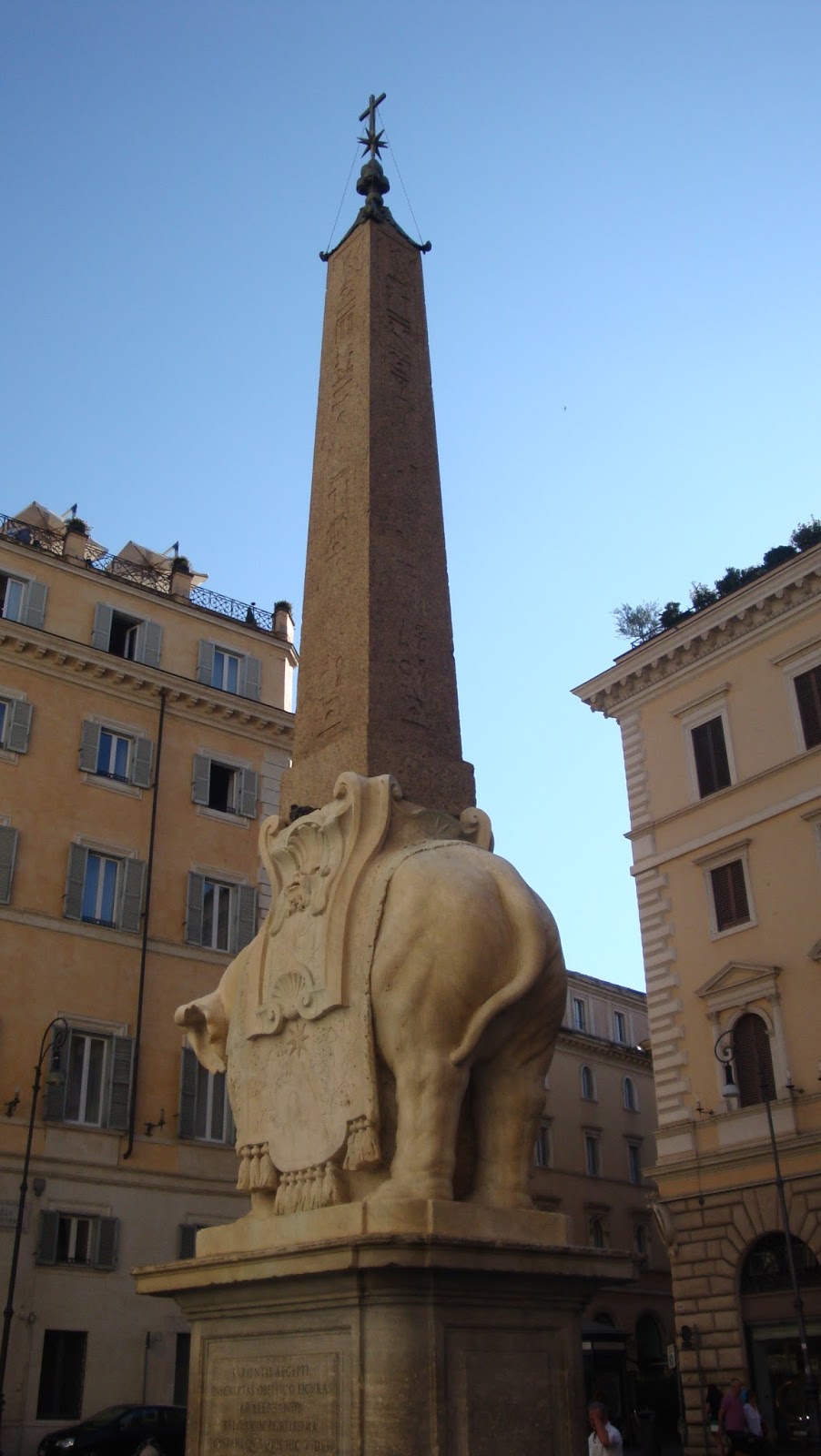
One of the most unusual aspects of this church is encountered in the piazza just outside. There stands a huge obelisk with an elephant holding it up. Bernini was commissioned to complete this work and had recently been inspired by a book he was reading. In 1665 a small obelisk was found in Rome. It was one of many Egyptian spires that once decorated a pagan temple here in Rome. Pope Alexander VII decided to have it placed in front of the church and hired architects to design a monument. One of the architects was a Dominican priest by the name of Father Domenico Paglia. There was some level of dispute between the priest and the sculptor, Lorenzo Bernini. The pope chose Bernini's design because the elephant symbolized strength and fortitude. Fr. Domenico and Bernini disagreed with some of the elements of the design and, in protest, Bernini pointed the tail of the animal towards the Dominican monastery as a sign of his protest in altering the original design!
Michaelangelo's sculpture of Christ the Redeemer stands at the left of the sanctuary. He had found a very small grey vain in the marble and completely abandoned the project once begun. His students picked up where he left off (he was a perfectionist) and completed the work. The body of St. Catherine of Siena lies in this church just under the main altar. Interestingly the present sacristy is a place where Galileo was tried in 1633.
San Ignazio (St. Ignatius) Church is a remarkable place as well. Back in the days of the Enlightenment, people believed if you couldn't see it, you
shouldn't believe it. The architect of this infamous church wanted to prove they were wrong. Sometimes what we see isn't the whole picture; isn't the whole reality and he set out to prove it through the architecture and the decoration of this church. Despite the fact that the church has only a slightly curved ceiling, the figures appear three dimensional, depending on where you stand. Further, the dome of the church appears similar to the dome of the Pantheon but it is, completely, an optical illusion. Standing near the door of the church it appears 3 dimensional. However, standing directly above the center and you'll see the dome is only painted on and is, in fact, not in the center of the church. Amazing!
We began our walking tour just outside the senate building at the Piazza Navona. Around the corner is a place called Piazza Eustachio. Interestingly enough St. Eustachio is the patron saint of hunters. Notice the cross with the antlers at the top of the church. This is the image you see on a bottle of Jaegermeister.
Santa Maria Sopra Minerva is a Dominican Church and it's the only gothic church in Rome. Built in the year 1286 when the papacy was in Avignon, the Dominicans were able to keep raising funds to build the church. It is breathgaking with lapsis (blue) ceilings and marble pillars. St. Catherine of Siena's body is entombed just below the main altar. She is heralded in helping to reunite the papacy in a single place - in Rome. When it came to who would repose her body there was a dispute between the Siennese and the Romans. They compromised and decided her body would be in Rome, her head and finger would be in Siena. Only in Italy :).
| The Elephant signaling to Fr. Paglia |
Michaelangelo's sculpture of Christ the Redeemer stands at the left of the sanctuary. He had found a very small grey vain in the marble and completely abandoned the project once begun. His students picked up where he left off (he was a perfectionist) and completed the work. The body of St. Catherine of Siena lies in this church just under the main altar. Interestingly the present sacristy is a place where Galileo was tried in 1633.
San Ignazio (St. Ignatius) Church is a remarkable place as well. Back in the days of the Enlightenment, people believed if you couldn't see it, you
shouldn't believe it. The architect of this infamous church wanted to prove they were wrong. Sometimes what we see isn't the whole picture; isn't the whole reality and he set out to prove it through the architecture and the decoration of this church. Despite the fact that the church has only a slightly curved ceiling, the figures appear three dimensional, depending on where you stand. Further, the dome of the church appears similar to the dome of the Pantheon but it is, completely, an optical illusion. Standing near the door of the church it appears 3 dimensional. However, standing directly above the center and you'll see the dome is only painted on and is, in fact, not in the center of the church. Amazing!
Fr. Raniero Cantalamessa - Preacher to the Papal Household
We are fortunate to experience a retreat week at the Casa O'Toole (at the North American College) with preacher to the papal household, Rev. Raniero Cantalamessa, OFMCap. When people remark to him that it's a great honor to do this he claims it honors the pope more than it does the preacher. The position goes back to 1555 under the efforts of Pope Paul IV for the reform of the Church and the Curia. Since 1743 it has been the task particularly held by someone from the order of Capuchin Friars Minor. The role consists of presenting a meditation to the pope, cardinals, bishops, prelates of the Curia and superior generals of religious orders every Friday in Advent and Lent.
What is truly amazing about this man is not so much WHAT he preaches, it's HOW he preaches. You can tell it comes not only from his head but his heart as well. It is a synthesis of his own life of prayer and reflection. Further, his conversion experience really has it's foundation in the charismatic movement. He had been invited to the Charismatic Renewal in Kansas City years ago and discovered something about the Word of God that inspired him. He said it was no longer just words on pages but a lived word that needed to "go forth."
Cantalamessa has preached to John Paul II, Benedict XVI and now, Pope Francis. He's given two talks before both conclaves that elected the last two popes. He tells the story about how Pope JPII had been traveling to Central America during Lent and missed two sermons. Upon his return he apologized to Cantalamessa for having missed his sermons. In reflecting on this, the preacher of the papal household said, "Have you ever gone to your parish priest and asked pardon for missing the homily of the previous Sunday?
Fr. Cantalamessa's first talk this morning was about living from the spirit and his homily at Mass challenged us to look beyond the "front" of the cross to the "back of the cross." He said it is not just recalling the historic event of Christ's suffering but looking beyond that to the glory of the Resurrection. It's a great reflection for us, at Holy Angels, as we prepare to erect a new crucifix next year!
I am eagerly anticipating more from this inspiring and inspired preacher!
What is truly amazing about this man is not so much WHAT he preaches, it's HOW he preaches. You can tell it comes not only from his head but his heart as well. It is a synthesis of his own life of prayer and reflection. Further, his conversion experience really has it's foundation in the charismatic movement. He had been invited to the Charismatic Renewal in Kansas City years ago and discovered something about the Word of God that inspired him. He said it was no longer just words on pages but a lived word that needed to "go forth."
Cantalamessa has preached to John Paul II, Benedict XVI and now, Pope Francis. He's given two talks before both conclaves that elected the last two popes. He tells the story about how Pope JPII had been traveling to Central America during Lent and missed two sermons. Upon his return he apologized to Cantalamessa for having missed his sermons. In reflecting on this, the preacher of the papal household said, "Have you ever gone to your parish priest and asked pardon for missing the homily of the previous Sunday?
Fr. Cantalamessa's first talk this morning was about living from the spirit and his homily at Mass challenged us to look beyond the "front" of the cross to the "back of the cross." He said it is not just recalling the historic event of Christ's suffering but looking beyond that to the glory of the Resurrection. It's a great reflection for us, at Holy Angels, as we prepare to erect a new crucifix next year!
I am eagerly anticipating more from this inspiring and inspired preacher!
Saturday, September 12, 2015
The Italian wedding!
On Thursday evening I celebrated a wedding Mass here in Rome. It was for a couple from Holy Angels - Catherine Lanzilotti and Eric Schober. Three of the Lanzilotti clan were there - Catherine (of course!), Christine and Christopher. Also present was Henry, a young man from Chagrin Falls. The wedding was beautiful. Held in San Giovanni a Porta Latina, it was a little church not far from the Circus Maximus. The wedding was held a little after 4:00 p.m. The sacristan, a little old lady in her 80's or 90's, greeted me but spoke very little English. I spoke very little Italian so we were a good match for each other. She prayed the rosary in Italian. I prayed the rosary in English. When the wedding was completed, she took my hand, led me over to the fresco of the Virgin Mother, and we held hands together, singing the Ave Maria in Latin. It was definitely one of the beautiful highlights of the wedding for me.
Later that evening - at 8:00 p.m. we met in Trastevere (a neighborhood of Rome) where we gathered Eatwith.com" It's a wonderful movement that gathers people around local tables and cuisine as they are visiting foreign places. There are a handful of such spots in Rome. You sign up online and never quite know who the other visitors will be. We gathered with 13 people in total. A couple and a friend from San Francisco. A single woman traveling from New Mexico and a young couple from St. Louis, Missouri. There were six in the wedding celebration group. It was a spectacular night.
for dinner in the home of a woman whose name is Barbara. Barbara is part of an international movement called "
We began with appetizers of puffed pastry with mushrooms and bruschetta. Then we moved too the pasta dishes - lasagne with a white mushroom sauce, stuffed tomatoes with rice, homemade gnocchi with a green olive sauce, veal with potatoes and red peppers. With wine, wine and more wine!!! To top it all off, she had an Italian creme cake which was awesome. It was topped with 3 gummy figures - one representing bride, the other groom and me! We didn't leave her home until Midnight. It was awesome. If you'd like to see a video of Barbara and her work, check it out here: http://www.eatwith.com/host/3875/.
Congratulations to the new Mr. and Mrs. Eric Schober!!!!!
for dinner in the home of a woman whose name is Barbara. Barbara is part of an international movement called "
We began with appetizers of puffed pastry with mushrooms and bruschetta. Then we moved too the pasta dishes - lasagne with a white mushroom sauce, stuffed tomatoes with rice, homemade gnocchi with a green olive sauce, veal with potatoes and red peppers. With wine, wine and more wine!!! To top it all off, she had an Italian creme cake which was awesome. It was topped with 3 gummy figures - one representing bride, the other groom and me! We didn't leave her home until Midnight. It was awesome. If you'd like to see a video of Barbara and her work, check it out here: http://www.eatwith.com/host/3875/.
Congratulations to the new Mr. and Mrs. Eric Schober!!!!!
Tour of St. Peter Basilica
Our Tour of the Vatican yesterday was conducted by a marvelous history teacher named Liz Lev. She not only knew the history but incorporated art and theology into her presentation. It was simply incredible!
We first stopped at the entrance way to St. Peter Basilica completed in . There on the floor was a red porphory disk called the Rota Porphyretica. This disc was originally located in the old basilica. When it was torn down during the Renaissance the disc was spared and installed on the new basilica at its present location. This disc is significant because it is the place where Charlemagne knelt on Christmas night in the year 800 A.D. when Pope Leo III crowned him as the emperor of the Holy Roman Empire. However, when this occurred the disc was already 500 years old meaning the disc has been there for 1,700 years! Emperors were crowned on this disc throughout the middle ages. If you've been to St. Peter's you've probably walked over it and never even realized it's significance and history!
Our second stop was at Michelangelo's most beautiful piece - the Pieta. This work is most significant for many reasons. It is his first public work, carved when he was only 23 years old. The completion of the entire basilica would be Michelangelo's last public work. It also was carved from a single piece of marble. The Pieta image is not found in Sacred Scripture. Rather, it was first proposed by the Germans in the 14th century. Pieta means "to feel sorry for." The French and Germans pieta works
were somewhat morbid. Jesus is in rigor mortis. Mary appears to be in trauma. Big gaps form wounds in his side. Tears were carved into the wood. It was, emotionally speaking, a lot for people to handle. So Michelangelo was asked to carve a Pieta from this subject matter. Michelangelo had vision and confidence in his abilities. He carved the complete work in a single year completing it for the Holy Year 1500.
There is a problem with the placement of the Pieta. You may remember that, in 1974, an Australian geologist took a hammer to the sculpture and began destroying it. After restoration it was placed behind a glass wall. It was never the intention of the patron to be placed so. He had expected that Mass would be celebrated on an altar in front of the sculpture. When the host was raised, Mary would have been gazing upon it, anticipating her son's presence in the Eucharist. Further, the entire work points to the resurrected presence of Christ and would have been a theological background for the celebration of Mass.
In this work, Mary becomes a "living shroud." There is a triangular shape to the sculpture with Jesus folded onto the lap of Mary, his mother. The shoulder is carried under his mother's arm. Mary, as a daughter of Israel, now offers her son in sacrifice. His body appears to drop right in front of what previously had been an altar. Mary's fiat is "let it be done to me according to your will" and she now gives the Church it's savior. The folds of Mary's garment appears to be heavy (a sword will pierce her heart) but Jesus' body is so polished that it reflects the light shining from him. Sad as the subject matter is, there are already signs of the Resurrection emanating from the reflection of light from Jesus' body.
This is the only work that Michelangelo ever signed. If you look closely you can see the signature on the sash of Mary's garment. After the piece had been placed in the basilica, Michelangelo overheard someone remarking that it was the work of another sculptor, Cristoforo Solari. It was after this that the sculptor wanted everyone to know it was his piece. Therefore, he carves the words MICHAELA[N]GELUS BONAROTUS FLORENTIN[US] FACIEBA[T - translated, Michelangelo, the Florentine, made this.
One of the things that strikes you as you walk into the Basilica is the sheer size of the building. It can seat 60,000 people making it the largest church in the world. Remember that the people of Rome would have been accustomed to praying in pagan temples. These temples were small in size because their religions were exclusive. One of the things that set Christianity apart is that size indicated to all that 'everyone was welcome." We have triumphed, in engineering, over the people who worshiped gods dressed as birds. Michelangelo sought to create that sense through architecture. He visited the Pantheon and saw the massive dome. You're so aware of the presence of that dome and how it holds up the supporting walls. The Romans wanted to show off the skills of man. However, Michelangelo sought to show the connection between heaven and earth. He wanted to build this massive dome over the bones of St. Peter, the "rock" of the Church and connection between heaven and earth. The windows allow light to shine, breathtakingly through. You forget that there are 137 tons of masonry above your head. Here is a place where heaven and earth meet.
The bronze statue of St. Peter is 700 years old. It was sculpted for the first jubilee year in 1300. Significant to this piece is that Peter is not dressed like a king. In fact, he's wearing a philosopher's robe and dons a beard signifying wisdom. This was a significant change from the Byzantine depictions of Peter as emperor of the kingdom of God. Think about visitors to the basilica in 1300 - they were interested in touching the sacred places and grounds in the holy land. They began to touch the foot of St. Peter in reverence to the first pope. Over the years the foot has been worn down by the touch of pilgrims' hands. Liz noted that it usually takes 1500 degrees and a soldering iron to change bronze. But here, at St. Peter's, 98.6 degrees, from pilgrims hands over the course of 700 years and bronze is worn and re-shaped by the hearts and prayers of millions.
The Baldacchino or canopy placed under the dome of the Basilica and over the tomb of St. Peter was commissioned by Pope Urban VIII in 1623 and was completed several years later. It was intended to give a greater significance to the tomb of St. Peter and marking the spot, without any doubt, where he was laid to rest. Further, under the canopy is the altar upon which the Holy Father has Mass. This is yet another place where the vicar of Christ connects us between heaven and earth. This massive canopy is 75,000 pounds! Initially Bernini had difficulties getting the canopy to stand. After all, carved in bronze this canopy is the size of a 3 story building within another massive building. Significant to the twisted design of the columns is the fact that the Romans and Greeks would never have designed them this way. It was simply not the way they defined space. Above the area of the canopy are columns originally created in the Constantine era. They were designed and placed above Peter's tomb originally and were brought into the design of the Basilica. Bernini used the same "twisted" design for his columns on the canopy. Liz pointed out a significant theological connection. Christianity has always been "different" than the culture around it. Rather than defined, accurate, and precise columns, Bernini hoped to portray that Christianity is sometimes jarring, surprising and provides somewhat of a "twist" to modernity and is often counter-cultural. It never stands in line with the nice order people try to put together and impose on life. They also offer us continuity - we may have rebuilt the church but it's the same Peter around it.
Liz tells us that 17th century is her passion. It was the age of discovery. When Bernini was 17 years Galileo shows up in Rome with a telescope. Bernini would have looked at worlds beyond through that telescope and began to have a vision and perspective on life beyond this world. All of St. Peter's Basilica does just that - it transports you to a world beyond this one. And, for the last 400 years, it has done so for millions and millions of pilgrims from around the world.
Around the center canopy are several sculptures. One depicts St. Helena and contains a relic of the true cross. Another depicts St. Veronica. But the two she focused on were the statues of St. Longinus and St. Andrew. St. Andrew was sculpted by Francois Duquesnoy. In this depiction, St. Andrew appears, bare chested, gazing at the cross, looking outward. He appears on a satire cross (like the shape of a letter X). There is nothing spectacular about the folds of his garment.
On the other side of the nave is St. Longinus. Tradition holds that he was the guard who pierced Jesus' side when blood and water come out. Think about it. Longinus is a Roman guard, part of the winning team. Jesus was the prisoner and he was the soldier. He was just doing his job as a soldier when Jesus was crucified. But now, when he pierces the body's side, blood and water flow out and he now realizes - this was the son of God. His garment appears to have been electrified and his hand is fully opened as if an awareness has happened unknown to him before. He holds a lance in one hand and the other is wide open as if shocked by what he has just experienced and seen.
Bernini was 73 when he began to work on this funerary monument for Pope Alexander VII. They both had a fascination with the art of dying well. Alexander was so worried that death would capture him unexpectedly, unprepared. So Bernini made him a little wooden coffin "you do not know the day nor the hour" to remind Alexander of death. Beautiful marble - greens, blacks, grays remind us of the beauty of this world. But the big red theater curtain is the most significant piece of this scultpture. Death - gold skeleton with an hour glass - below the curtain. This provides absolute certain of death. Virtues are around the bottom of the curtain - charity, prudence, fortitude. The woman with the sun - moral truth. Her toe hovers over England - and there's a little thorn that pokes into her toes indicating that England was a thorn in the church's side. This is one of my favorite pieces in St. Peter's. I have reflected before it often.
This incredible tour gave me insights into the Basilica that I had never had before. I look forward to further tours with Liz Lev regarding more works of art and architecture throughout Rome and Assisi.
![]() |
| The Rota Porphyretica - St. Peter Basilica |
Our second stop was at Michelangelo's most beautiful piece - the Pieta. This work is most significant for many reasons. It is his first public work, carved when he was only 23 years old. The completion of the entire basilica would be Michelangelo's last public work. It also was carved from a single piece of marble. The Pieta image is not found in Sacred Scripture. Rather, it was first proposed by the Germans in the 14th century. Pieta means "to feel sorry for." The French and Germans pieta works
| The Pieta by Michelangelo, 1500 |
![]() |
| Dome of St. Peter Basilica (notice the beam of light) |
The Baldacchino or canopy placed under the dome of the Basilica and over the tomb of St. Peter was commissioned by Pope Urban VIII in 1623 and was completed several years later. It was intended to give a greater significance to the tomb of St. Peter and marking the spot, without any doubt, where he was laid to rest. Further, under the canopy is the altar upon which the Holy Father has Mass. This is yet another place where the vicar of Christ connects us between heaven and earth. This massive canopy is 75,000 pounds! Initially Bernini had difficulties getting the canopy to stand. After all, carved in bronze this canopy is the size of a 3 story building within another massive building. Significant to the twisted design of the columns is the fact that the Romans and Greeks would never have designed them this way. It was simply not the way they defined space. Above the area of the canopy are columns originally created in the Constantine era. They were designed and placed above Peter's tomb originally and were brought into the design of the Basilica. Bernini used the same "twisted" design for his columns on the canopy. Liz pointed out a significant theological connection. Christianity has always been "different" than the culture around it. Rather than defined, accurate, and precise columns, Bernini hoped to portray that Christianity is sometimes jarring, surprising and provides somewhat of a "twist" to modernity and is often counter-cultural. It never stands in line with the nice order people try to put together and impose on life. They also offer us continuity - we may have rebuilt the church but it's the same Peter around it.
Liz tells us that 17th century is her passion. It was the age of discovery. When Bernini was 17 years Galileo shows up in Rome with a telescope. Bernini would have looked at worlds beyond through that telescope and began to have a vision and perspective on life beyond this world. All of St. Peter's Basilica does just that - it transports you to a world beyond this one. And, for the last 400 years, it has done so for millions and millions of pilgrims from around the world.
| St. Andrew |
Around the center canopy are several sculptures. One depicts St. Helena and contains a relic of the true cross. Another depicts St. Veronica. But the two she focused on were the statues of St. Longinus and St. Andrew. St. Andrew was sculpted by Francois Duquesnoy. In this depiction, St. Andrew appears, bare chested, gazing at the cross, looking outward. He appears on a satire cross (like the shape of a letter X). There is nothing spectacular about the folds of his garment.
![]() |
| St. Longinus |
On the other side of the nave is St. Longinus. Tradition holds that he was the guard who pierced Jesus' side when blood and water come out. Think about it. Longinus is a Roman guard, part of the winning team. Jesus was the prisoner and he was the soldier. He was just doing his job as a soldier when Jesus was crucified. But now, when he pierces the body's side, blood and water flow out and he now realizes - this was the son of God. His garment appears to have been electrified and his hand is fully opened as if an awareness has happened unknown to him before. He holds a lance in one hand and the other is wide open as if shocked by what he has just experienced and seen.
This incredible tour gave me insights into the Basilica that I had never had before. I look forward to further tours with Liz Lev regarding more works of art and architecture throughout Rome and Assisi.
Subscribe to:
Posts (Atom)